

I Can’t Always Count on My Eyes: Brit Hancock presents at Vision Health Canada Conference

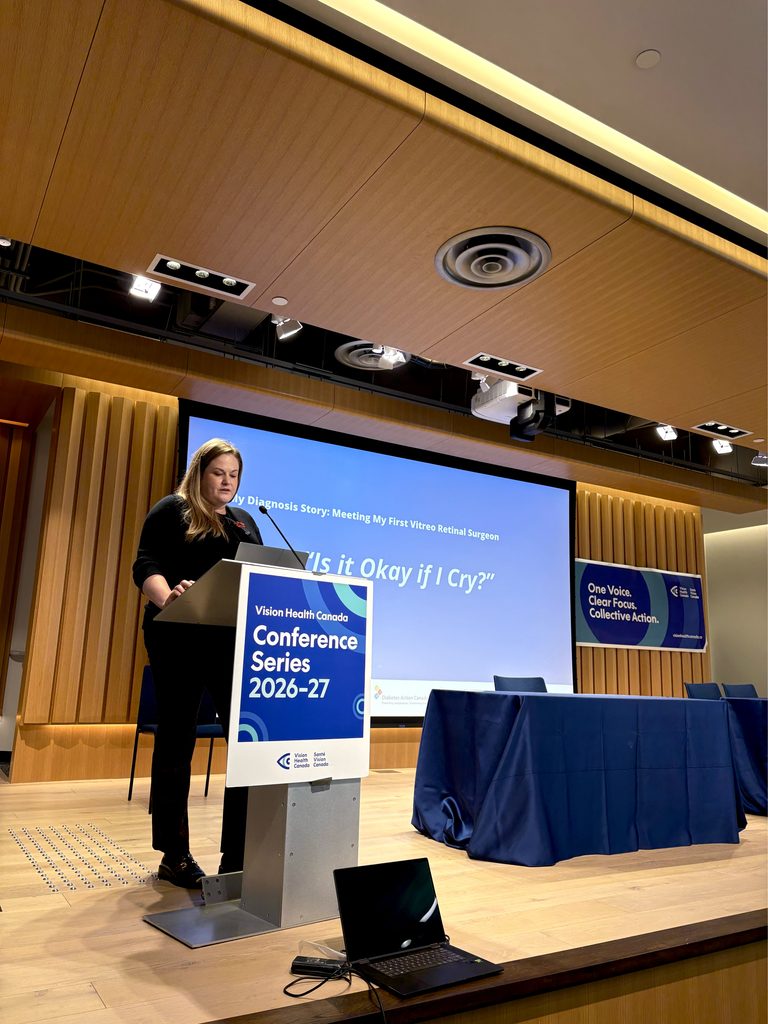
Brit Hancock, Program Assistant for the Research-to-Action Fellowship and a 2025 Fellow, shared her lived experience with advanced diabetic retinopathy at Vision Health Canada’s 2026 Conference Series: The Diabetes and Diabetic Retinal Disease Conference.
The conference theme, Diabetes and the Eye: Seeing the Signs, Saving the Sight, brought together leaders in vision health, diabetes, research, and screening. Keynote speaker Dr. S. Robert Levine, Founder and CEO of the Mary Tyler Moore Vision Initiative, discussed diabetes and diabetic retinopathy. Dr. Shane Green, Senior Vice-President of Mission at Diabetes Canada, spoke about diabetes and its impact on Canadians. Dr. David Wong, Ophthalmologist-in-Chief at St. Michael’s Hospital (Unity Health Toronto), shared the current research landscape for diabetic retinal disease in Canada, while Josie McGee of Vision Loss Rehabilitation Canada discussed screening tools for early diagnosis. Brit brought the perspective of a person living with diabetic retinopathy and working in patient partnership.
Brit presented the 2025 Fellowship project she developed with her team partner, Fizza Abbas, with support from Laurie Lepine and Linxi Mytkolli. When Words Hurt and When They Heal is a research-informed, community-led project that explores how language in diabetes care can hurt or heal. It includes a nursing education toolkit with a pre-recorded presentation, facilitation guide, and reflection resource.
Diagnosed with type 1 diabetes at age two, Brit was diagnosed with advanced proliferative diabetic retinopathy at age 29. In her presentation, she described the uncertainty of living with vision that can change suddenly, and how the experience has affected more than her eyesight.
The first question Brit asked her specialist after receiving eye injections was, “Is it okay if I cry?”
She had just heard that, without immediate treatment, she could be blind within three months. Her specialist used a series of analogies to explain her condition and treatment options, including a truck going down a mountain without brakes. Brit said that when she was frightened, much of the conversation became a blur. She left with more appointments for injections and laser treatments, but didn’t fully understand what was happening to her.
She emphasized the importance of clear and effective communication between doctors and patients. She encouraged clinicians to see patients as people, recognize their individual needs, and communicate essential information in ways that are meaningful, accessible, and easy to understand.
Brit shared that her experience with her second and current vitreoretinal surgeon, Dr. Tom Sheidow, was different. He took the time to answer her questions and helped her feel comfortable discussing her concerns. He also told her, “Diabetes is an incredibly difficult disease. Complications do not equal effort.”
For the first time, Brit said, she left a specialist’s appointment feeling truly seen. His words helped her begin to look at her complications differently and let go of some of the self-blame she had carried. She connected that blame to messages she heard growing up about a family friend who lost her sight “because of diabetes.” Rather than ask why her friend hadn’t taken care of herself, Brit now asks, “Where was her support?”
In her presentation, Brit reflected on the impact of stigmatizing language in clinical settings and emphasized that what a clinician intends to say may not always be what a patient hears. She also spoke about the importance of including people with lived and loved experience in developing research, resources, and services.
She concluded with a call to action for attendees to take the End Diabetes Stigma Pledge, reinforcing the message that communication shapes culture, and culture shapes patient care.
Featured in Article

Associated Programs

Diabetic Retinopathy Screening

Reducing the Risk of Diabetic Retinopathy
Episode five looks at Project OPEN and its potential to reduce the risk of diabetic retinopathy. Malcolm Sissmore and Dr. Michael Brent from UHN Research discuss how this program is trying to make eye screening much more accessible for people living with diabetes.

A Data-Informed Approach to Improving Access to Eye Screening

When Intention Creates Connection: Reflections from Night One at the Global End Diabetes Stigma Summit
