This is part four in a series of blog posts written by Patient Partners about the Diabetes Action Canada Workshop.
About Ryan: Ryan Hooey: A person living with Type I Diabetes for 30 years. An advocate for the affordability, availability, and accessibility of diabetes management technology for all. Located in Windsor, Ryan has been a Patient Partner for approximately 3 years. Fun fact: I wish that items created to treat low blood sugar tasted terrible so I would not want to eat them.
This was a conference like no other. It was unique in several different ways. For starters, no one had any identifying credentials on their name tags, so the conversation flowed naturally without any intimidation of titles. This was a breath of fresh air, as whether it be a group setting or one-on-one with a scientist, researcher, or endocrinologist, patient partners did not have to feel overwhelmed to speak the truth or share how they might not be the “perfect” person with diabetes. It was evident that real conversations were taking place all over the conference between people from all over Canada, speaking about their journey with diabetes.
Another thing that differed from other conferences I have attended was the notion that patient partners were the focal point, and all the breakout sessions, group discussions, and events were geared towards patient partners with lived experience. This extended right down to the menu and timing of the agenda to allow attendees to bolus without worrying about lag time and a rollercoaster of blood sugars.
I absolutely loved the connection to Indigenous culture and their representation within the diabetes community. There were so many group discussions and even a culturally respectful gathering the evening before the conference started regarding racism. Hearing the thoughts from those who attended this was so thought-provoking. A few times during this, I heard that this was the first time someone felt comfortable speaking in this forum.
Another experience that was a first for me was the session about homelessness and diabetes. I never knew this was such a critical issue so many are experiencing. There was a film shown to the entire conference, and I felt like this was a very real portrayal of the difficulties facing people who are homeless and live with diabetes. I would urge you to check it out if you have not seen it. The cost of food for those seeking shelter was a real concern in this film, yet something I would have never considered.
On the final day of the conference, myself and two others were awarded the DAC Catalyst For Change award. I want to congratulate the others who won this award because you are doing fantastic things in the world of diabetes. For me, this was humbling, and it gave us the chance to speak about how important having patient partners be a part of your research or project is. Living with diabetes is different for each and everyone out there who manages this daily. We never get a day off, whether it is a Wednesday or your birthday, we have to make a million little decisions that ultimately will affect our blood sugar levels, maybe even several hours into the day. Being able to express this alongside the two award winners who have had very different journeys than myself was an honor.
As a person living with diabetes, you can come to the table with so many questions, concerns, and essentially problems. But you become a patient partner when you come with those concerns but also a solution.
This is the third in our series of blog posts, written by Patient Partners, about their experience at the Diabetes Action Canada Workshop.
About Shayla:My name is Shayla Hele. I am 26 years old and have been living with Type 1 Diabetes for 19 years. I have been a part of the Collective Patient Circle at Diabetes Action Canada since 2016. I currently live in Halifax, Nova Scotia, and I love dirty chai lattes.
I have been attending the Diabetes Action Canada (DAC) conferences since the first conference in 2017. It is almost intangible how far we have come since then, with substantial progress being made every year. For myself, what made this conference a particular success was the incorporation of research using art and creativity as a means of conveying qualitative data. The Reshape T1D Collection, the film Low, and the Home Sweet Home(less) photo exhibit were individually and collectively phenomenal. I have never felt so engaged at a DAC conference as I did with each of these pieces. I believe this is in large part a result of the direct involvement of individuals living with diabetes in the development and implementation of these projects.
I am not a researcher, bear in mind, but from my understanding and experience, the consequences of research often go unseen or take years to create meaningful change. These projects, in contrast, felt as though they held direct impact. Perhaps they cannot amplify the rate of change in policy, but from how they made me feel, I am hopeful they will. I believe that art offers a vulnerability and personability that speaks louder than numbers and conclusions. When there is something more tangible than a piece of paper driving actions, I believe we may see different outcomes. I believe this also holds true in terms of knowledge mobilization, which is something I know DAC has been working to amplify since its outset.
All this is to say, I felt profoundly moved and motivated by this conference. In previous years, I have found it difficult to hold my attention while researchers presented their projects, discussing protocols or outcomes I did not understand, could not see the implications of, or could not directly relate to. This deterred me from meaningfully engaging with poster presentations and researchers one-on-one because I felt I did not know how. This year felt different, and it was refreshing. It felt as though in every project being presented, both qualitative and quantitative, I could see myself (or someone else with lived experience) shining through. This created space for me to connect with each project; the outcomes, the patient partners, and the researchers; and it felt empowering and exciting.
I am very proud to be a part of this organization and to have had the opportunity to watch it grow into something so powerful. I am thankful to have been given the opportunity to use my voice and be heard. I am also very grateful to all the other folks with lived and loved experience for sharing their expertise. I also thank all the folks at DAC who have worked and who continue to work tirelessly towards our shared goals.
This is part two in our series of blog posts written by Patient Partners about their experience at the Diabetes Action Canada Workshop.
About Sasha:Sasha Delorme is a happily married Métis woman with two sons and two stepchildren. She grew up in a small town in Saskatchewan with her mother, who was adopted through the 60s Scoop, so she is learning about Indigenous culture as she works on projects and speaks about life with diabetes. Her son has type 1 diabetes (diagnosed at age 2 in 2014), and she has type 2, diagnosed in 2020.
Sasha has spoken at several events, helped plan many diabetes related events in her city for Diabetes Canada and JDRF, done grant reviews, contributed to the work of published scientific projects, and recently helped plan and host an anti-racism in healthcare workshop. She works closely with the Indigenous Patient Circle in Diabetes Action Canada as well as the Collective Patient Circle, always eager to help shape diabetes research. She has been on the DAC steering committee, Sex and Gender research committee, and knowledge and mobilization committee. She is currently a steering committee member for CommuniT1D, a mental health initiative for people living with T1D.
Sasha is starting a new position as Research Coordinator for the CanScreenT1D project and will be visiting Indigenous communities while she works with her fellow IPC members.
This year, 2024, I was reminded that I’m no longer at the conference sharing just my experiences as a mom/caregiver to my son with type 1 diabetes. I’m also there as a woman with type 2 diabetes. I hit my first scary low in a long time and, of course, it ended up happening right before my group’s presentation. I walked through the big doors to the area near the elevators and realized in that moment that I was really low. The second I realized… Linxi popped up and saved the day. She asked me how I was, and I said “low.” She panicked and found me some candy and fruit snacks, then waited a good 15 minutes to make sure I was okay. Not all heroes wear capes. Thanks again, Linxi!
I ended up nailing the speech (or so I thought in my haze, lol), and I know it’s because of the confidence I’ve built over the years, working for this organization and attending these conferences.
That being said, I have been to at least five conferences and this one was by far my favorite. All the details really made it epic. The menu was sent via email with carb counts so people could give insulin knowing the amount, there were no accolades on the name tags which made it easier to approach someone and ask how they’re involved with DAC. The “speed networking” session where we had the chance to meet people we otherwise may not have, and the family photos of DAC administration added a human element I found was lacking in other conferences. Showcasing the work that has been done and the results that have come from projects advised by patient partners was great to see. We need to share more of that news between our peers.
The hotel was beautiful and clean, and the food was really good. I enjoyed the breakout sessions and the length of the presentations were perfect, not too long. People were meeting each other for the first time since Zoom meetings became a thing, and everyone seemed happy to be there.
I left the conference feeling confident and ready to tackle more work with amazing people. I felt valued and safe, and it’s important for me to be in those kinds of environments. Thank you for all the hard work you put into this year’s meeting. A+++!!!
Several of our Patient Partners provided blog posts about their experience of the recent Diabetes Action Canada Workshop. We’re excited to share them with our community. Here is the first in the series, from Patient Partner and Research to Action Fellowship award winner, Al Martin.
About Al:My current vocation is as a heavy haul trucker. As a husband and father of two teenagers, I have a busy life, but I also enjoy riding my motorcycle, writing, and studying science. Recently, I’ve taken on a role as an advocate and patient partner with DAC and Obesity Canada to help all people whose lives are touched by disease and medical issues. My aim is to support those in the industry, celebrate what’s great, fix what isn’t quite right, and build something new where needed.My passion is to champion the need for the ubiquitous inclusion of mental health in all healthcare. My wife and I both live with type 2 diabetes and obesity. We’ve also experienced the impact of these conditions with our fathers – we have “loved” experience in addition to our own lived experiences; mine passed in January 2023, and hers is still going strong in his 80s.
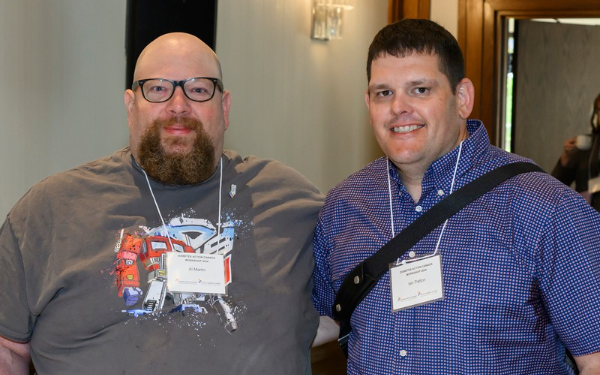
Al with Ian Patton from Obesity Canada at the Workshop
My float has a broken weld, which probably had a hidden crack for a couple of weeks. Today, it gave in to the daily toil of moving massive objects great distances. We found the issue, chained it up, and headed back to the shop for repairs. That’s how my day started on the first day of the conference. As much as I dislike bad analogies, sometimes we want to take a picture while holding a potato.
My body has been working hard for a long time and has needed a few trips to the shop for repair. Surgery two weeks before the conference was a bit of a surprise. The broken weld led to me finishing early, so off I rode to the conference, checking into a downtown Toronto hotel. My old hometown seems a bit surreal; no bellhops and concierge exist in heavy trucking, you’re a one-person crew. Solitude is the greatest thing—except when you need help.
I located our group. The room was full, and I knew only one of these people. They were mid-conversation. I wasn’t sure what was going on for about 35 seconds, but my brain churned as I heard the words of these great humans. It was obvious I was now immersed in the spirit of my people; patient advocacy was literally shooting out of them like firehoses. The talking stick couldn’t move quickly enough, and Linxi was bounding across the room to facilitate every single person’s interaction.
I was thinking fast and hard about the words I was hearing. I missed an important conversation and lesson from a couple of hours ago, but I knew the truths spoken were heartfelt because they overlapped with mine so many times. These are my people. They are passionate, tremendously engaged advocates who know the truth, hurt, and pain of being on the wrong end of good intentions inadequately backed and the daily machinations of the disillusioned. But in this room is a quiet power—the millions of hours collectively spent toiling at the millstone of chronic disease, caregiving, care receiving, and unrelenting pressure.
Day one, the passion was seething, but the lid was about to come off. I had the great pleasure of meeting Matt, my partner in the Fellowship Programme, who will work with me on “something awesome.” I met and got to know a few people. After supper, we exited for the pub and the Oilers game. Stories were told!
Some friends from other advocacy groups and research partners were there. I was humbled by the number of people who have dedicated their time to helping us and the chance to share my stories.
Day Deux
I was overwhelmed in the first five minutes when I realized how many people were presenting on the myriad of work done, along with the huge number of patient partners working on this. I officially met my colleagues in the Fellowship, sharing pleasantries after only knowing “of each other’s existence” and then the old Zoom call where my hands, more adept at shifting gears and chaining machines, were trying desperately to see my fellow fellows on tiny 1cm² blocks on my phone, nearly always hitting the wrong button.
“How did I get chosen? What can I offer?” It was humbling and difficult to hear that my life experiences were worth considering over anyone else’s. Perhaps my greatest fear is that I won’t have what it takes to rise to the level of my peers, many of whom have a solid background in academia. I’m an ACMZ driver but also a BMF, so I’m going to lay’er down best I can.
As usual, the presentations were inspired and hopeful, and the conversation outside the event was where the real work happened! There were a number of artful presentations in terms of visual arts.
I’d like to highlight every human I interacted with because I felt the love and respect from each and every one of them. A few standouts are Matt Langer, who will be my partner in the Fellowship project. Matt’s story involves a struggle with addiction, mental health, and homelessness. My own experiences intersect hard with his; addiction and mental health have affected my life since childhood, as my own father, also a diabetic patient, passed in January 2023 from undetected pancreatic cancer and other tumors. Matt worked on and was in the movie “Low.” The scene where a man suffers from a diabetic coma reminds me of when my wife and I checked on my father years ago when he let his sugars go unchecked and passed out. My wife, who lives with diabetes along with her own father, recognized the issue immediately while others assumed he was drunk. We got him to the hospital after getting him to drink some sugar-containing beverages. The fear and sadness of that experience flood back into me. I feel like I’ve been smacked by a bear trap binder right in the eye.
This movie, combined with the art and written exhibits outside, reminds me of the food “desert” I see in the trucking industry. Longer trips mean garbage food if I can’t get stopped near a grocery store. The resonance with foods available to the homeless is striking and needs thorough evaluation by society. Diabetics are not the only people in need of secure, reliable access to nutritive sustenance.
Another powerful experience was with Jasmine Maghera’s haunting images. Her painterly skill with composition, color, and texture brought me back to decades ago when I studied art in high school. One can’t help but be carried to the depths of a life punctuated by traumas and rebuilt strengths while locked with the images she’s painted and shared so beautifully with us. Anyone who’s lived or loved someone with trauma will be holding back tears in the presence of her work.
We were also treated to hear the stories of several Indigenous people who came to share and teach us about living with diabetes in communities that have been forgotten by many of us. My view of Indigenous people as a child was one of great respect for them, their lives in touch with the land, and their appreciation for our ancestors and our earth that sustains us. It breaks my heart to see and know how terrible their circumstances have been and how little care there has been for them. While I’ve lived my life somewhat distanced from their experiences, I feel great sorrow and grief over what they’ve endured. But I’m encouraged by their strength, courage, and determination to heal and spread love and kindness to all of us. The emphasis on building a relationship going forward while acknowledging and respecting the trauma of their past and present is truly important and impressive. It’s long past time to heal.
If those who have suffered mental illness, addiction, and lack of clean water and healthcare can heal and build a better system, I sure can too! It’s time to harness the spirit of these amazing humans. Their hearts and minds are powerful, and knowledge abounds. Respect for our earth and ourselves is evident in every word from the Indigenous people I met. Tamara, who ran to Winnipeg from the Cree Nation (look up proper spellings of names), is an inspiration for all of humanity.
I also want to shout out to Ryan, who lost his sight 12 years ago and has shown me things I have never been able to see with my working eyes. I only had a couple of short interactions with him, but his presence is very powerful because he’s showing us that obstacles can be navigated or blown away by simple advocacy and words to explain a better way to communicate.
As I packed up and grabbed my motorcycle from the garage, I arrived at the valet parking circle, found a place to pull my bike up, and got my bags. The bellhops had gone to get my old leather duffle and my two other ramshackle bags—what I carry in my tractor, what I strap to my bike. I thought of Katie, who checked out with me and talked to me several times. She’s a PhD candidate working in the field of her own chronic disease since the age of 3. An example of extreme professionalism, dressed in a pink blazer with a matching wheelie suitcase, she’s got the look my stylist fell flat on! But she’s got substance too—a kind soul, smart, and perhaps unaware of how much she embodies what we need to know. I think I chewed her ear off the last day with my rambling, but she showed me how to roll with it, be seen living life undeterred, and make a difference.
Back to my bike, strapping down bags, my boss called to discuss a difficult job for Monday morning. A 05:00 start—they wanted me to keep in touch and had already had one successful day on the project. I’m proud they trust me with this.
I’m also proud of my involvement with DAC and all the people I’ve mentioned above, and all the ones I didn’t. I wish I’d had time to share every conversation, like the ones I had with Kathleen, Heather, Jamie, and Ian.
Thankfully, though, my loquacious nature knows some bounds. When I’ve said everything I need to say, I simply go on for another hour…
I’ve got to say that was an awesome experience. I’m both exhausted and pumped, humbled and proud. Watch out, November is coming fast!
Diabetes Action Canada (DAC) is pleased to have Access Alliance as its latest Knowledge User partner. These partnerships foster more collaboration and support for ongoing patient-oriented research successes.
Access Alliance is a Community Health Centre, which has been serving Toronto’s marginalized, newcomer and immigrant communities for thirty-five years. They are focused on addressing the deepening disparities in society and leveraging the power of collaboration through systems change initiatives.
“Diabetes Action Canada is excited to partner with Access Alliance as part of our ongoing work to improve access to diabetic retinopathy screening. Reaching our most vulnerable populations is essential to saving sight and creating a healthier community,” says Tracy McQuire, DAC’s Executive Director. “We welcome the opportunity to engage with the communities served by Access Alliance to find solutions that make our healthcare system more accessible and equitable for those living with diabetes”.
This partnership is the second Knowledge User partnership for DAC, which has recently developed this option to increase collaborations beyond the research community. In order for projects to have real impact, they must reach the people who need them most.
“As a research-focused primary healthcare agency, Access Alliance generates evidence to inform program planning at the agency, builds the evidence-informed capacity of the community, and advocates community development through fullest community engagement to make a positive change at micro, mezzo, and system level. Our research and anecdotal service experience working with patients with diabetes and prediabetes will be expedited and enhanced meaningfully by our partnership and collaboration with Diabetes Action Canada. This will help DAC reach the deepest section of the community through our infrastructure and enrich our knowledge mobilization activities in a broader way to serve the community at large,” says Dr. Akm Alamgir, Director of Organizational Knowledge and Learning at Access Alliance MHCS.
In May, Diabetes Action Canada (DAC) awarded the first ever Catalyst for Change Awards to three Patient Partners.
The Catalyst for Change Award celebrates Patient Partners who have made outstanding contributions to advancing patient-oriented diabetes research and care, embodying transformative achievements in our community.
The 2024 winners are:
Kate Farnsworth – Mom of a daughter with T1D and supporting a family member with T2D, champion for DIY and other technologies to improve outcomes for people with T1D, and a longstanding member of the DAC Innovations in Type 1 program team.
Ryan Hooey – Person living with T1D and vision loss, advocate for increased accessibility and a member of DAC’s diabetic retinopathy screening program team.
Matt Larson – Person living with T2D, advocate for those experiencing diabetes and homelessness, and a long-time member of the Campbell Lab’s project aimed at improving outcomes for those experiencing homelessness while living with diabetes.
As with all DAC programs, Patient Partners were at the heart of developing this award and co-designing the nomination and selection processes.
“Our Patient Partners had requested this award for years,” says Patient Engagement Lead, Linxi Mitkolli. “We, as a team, did scoping and research on how other networks and organizations all over the world honour their patient partners. Then we brought the ideas to our Patient Partners to co-design how we would implement it.”
Patient Partners helped determine the nomination criteria, ensuring it was transparent and clear, and were part of the selection committee deciding. They participated in every step of the process, including suggesting and supporting a panel discussion by the winners at the DAC Workshop to give Patient Partners increased voice at the event.
Nominations were open to all members of the DAC community, including researchers, Patient Partners, and staff. Self-nominations were encouraged and appreciated.
At our recent Diabetes Action Canada Workshop, Dr. Jon McGavock introduced a video honouring the life of Patient Partner Clarence Nepinak, who passed away on November 2, 2022.
Nepinak was a respected Indigenous elder and community leader from the Pine Creek First Nation (Minegoziibe Anishinabe) in Manitoba. He was deeply committed to his community, and to improving health outcomes for all Indigenous Peoples. He and his wife, Barbara, helped found the Diabetes Action Canada Indigenous Peoples Circle and were tireless advocates for those living with diabetes.
He served on several advisory councils and boards, including the Indigenous Advisory Council at the Canadian Museum for Human Rights, the Elders Advisory Council at the University of Winnipeg, and the Indigenous Peoples’ Education Circle at Brandon University. He also worked with organizations such as the Healthy Aboriginal Network and participated in cultural events like the Winnipeg Folk Festival and the Festival du Voyageur.
Nepinak’s contributions to his community and beyond were widely recognized. He received multiple honors, including the Queen Elizabeth II Golden Jubilee Medal and the Queen Elizabeth II Diamond Jubilee Medal. In 2019, both Clarence and his wife Barbara were inducted into the Order of Manitoba for their dedication to advancing Indigenous culture (Home) (Manitoba Lieutenant Governor).
At the Diabetes Action Canada Workshop on May, the Network announced the awardees of the inaugural Research to Action Fellowship Award.
This unique fellowship runs from May to December 2024, and is designed for individuals with a personal connection to diabetes, offering an opportunity to turn their experiences into powerful advocacy and knowledge mobilization. The fellowship aims to give awardees the tools to make significant impact in the diabetes community.
The first cohort was chosen by the DAC selection committee from a pool of more than 60 applicants. Each one brings a unique set of strengths that will help them develop their initial projects.
Diabetes Action Canada is pleased to now be a member of Research Canada.
Research Canada is a national, broad-based alliance dedicated to advancing health research through collaborative advocacy. Their mission, which aligns well with DAC’s is, “to improve the health and prosperity of all Canadians by championing Canada’s global leadership in health research and innovation.”
Already, DAC has participated in one of Research Canada’s events, a Parliamentary Health Research Caucus on ‘Exploring the Future of Diabetes Treatment, Management and Prevention.’ There, DAC researchers Drs. David Campbell, Diana Sherifali and Lorraine Lipscombe spoke about advances in diabetes care. Patient Partner Tom Weisz was also a panelist at this event, sharing his own experience of living with type 2 diabetes and the importance of research to him.
The team at Diabetes Action Canada looks forward to continuing to build on this important collaboration.
On this latest episode of asPERusual – a podcast for practical patient engagement, host Anna Maria Chudyk interviewed our very own Tracy McQuire and Linxi Mytkolli to learn about the different ways in which our Strategy for Patient-Oriented Research network is committed to improving the lives of persons living with diabetes.
Regardless of whether diabetes is your research focus, this episode is of interest to anyone conducting interdisciplinary or knowledge-user-driven research. Tune in or read the interactive transcript to learn all about:
How Diabetes Action Canada | CIHR SPOR Network brings together diverse groups of knowledge users and guides them in finding a common language and space for them to work together to make better research, better policy, and better programs to better the lives of people living with diabetes;
Our innovative approach to evaluation (at the network and individual level);
The depth and breadth of involvement and engagement opportunities within the network, as well as their benefits; and
Key takeaways including the applicability of patient engagement across the spectrum of research and the need to democratize how we do patient engagement.